Tech Professionals
Divorce for IT Professionals and Developers is Complicated
Professionals in the Technology Industry – including computer programmers, software developers, and hardware/software engineers – face a specific set of issues during the divorce process. Some of these issues are obvious, and technology professionals and developers frequently ask a number of common questions at their initial consultation with a family law attorney. For example:
- How do you divide Restricted Stock Units or Stock Options that haven’t vested yet?
- Does the non-employee spouse have a right to unvested options or units? If so, how many?
Other questions about divorce and family law, however, are not readily obvious to tech professionals and their spouses. Suppose the court awards a non-employee spouse an interest in unvested Restricted Stock Options. Now suppose the software developer/engineer quits their job to take a new job at another software company. When a developer leaves their existing employer, they typically forfeit any unvested RSUs. So what happens to the non-employee spouse’s court-ordered interest in those unvested RSUs? Is it simply lost?
Or suppose the software developer is likely to be offered a better position in another state in the near future; if you’re still married, should you file for divorce now or wait until after the relocation? How will another state’s laws impact the division of property? And how will the timing of the divorce affect how new signing bonuses are allocated between the parties?
While perhaps not obvious to the parties themselves, these potential issues can have an enormous impact on the outcome in a tech divorce – which is why it is critical for IT and other technology professionals and their spouses to consult with and retain a knowledgeable family lawyer with plenty of experience in tech-sector divorce.

In Divorce for IT Professionals and Developers, Bonuses May or May Not be Community Property
Suppose the parties separate in August and the husband receives his Microsoft bonus package in September. Because the bonus occurred after the parties separated, you might be inclined to think it’s his separate property – but it might actually be community property. The answer turns on what the bonus is for.
If the bonus is awarded because of the husband’s stellar performance over the last year – a period prior to separation and during which his efforts belong to the marital community – then the bonus will be deemed community property. Think of this bonus as a delayed compensation that was being earned while the parties were still married.
However, if Microsoft characterizes the bonus as an incentive for the husband to work in the future, then the bonus will be his separate property. Think of this bonus as compensating the husband for work anticipated in the future – a period after separation and during which his efforts no longer belong to the marital community.
The same is true for signing bonuses. Suppose a software developer is given a restricted stock award at Amazon that fully vests in four years. After the four years are up, let’s suppose the worker lands a new job at Google and is rewarded with a generous signing bonus. If the developer filed for divorce prior to taking the new job at Google, then that signing bonus would probably be separate property.
However, if Google recruited the software engineer prior to the vest at Amazon, and Google offered an even bigger signing bonus in recognition of the abandoned unvested Amazon RSUs, a substantial portion of the Google signing bonus would, in effect, be a buy out of the abandoned Amazon RSUs. That fact would allow the non-developer spouse to argue that a good portion of the Google signing bonus – or at least that portion of it constituting the buy out of the community’s Amazon RSUs – belongs to the marital community.
Stock Options/RSUs Are Divided Based on A Time-Weighted Formula in Divorce for Technology Professionals
Restricted Stock Units and Stock Options are invariably awarded to technology professionals on a graded vesting schedule, usually between two to five years. That means that a RSU awarded today to a computer programmer might not vest until five years from now. Now, let’s suppose our hypothetical computer programmer separates from her husband in three and a half years. This presents two issues: first, determining how many of the RSUs, if any, get awarded to her husband; and second, figuring out how to actually transfer ownership of an unvested RSU.
Courts start with the premise that labor done – and wages earned – by either spouse during the marriage and prior to separation is community property. Labor done and wages earned after separation are the separate property of the laboring party. With that in mind, Washington courts view each vest in the schedule as delayed compensation for the prior year of work. So the vest at the start of year two is compensation for work done in year one; the vest at the start of year three compensates for work in year two; and so on. The character (whether community or separate) of the vested RSU is determined by the character of the labor that earns it. Returning to our hypothetical computer programmer, we start by constructing a timeline of the vesting schedule to which a court would then apply the above principles. For simplicity, let’s assume the programmer is awarded 100 RSUs on a straight, five-year vesting schedule (“Table 1”).

The 60 RSUs vesting one, two, and three years from now were all earned prior to the parties’ separation in 3 ½ years, so these are community property. The 20 RSUs granted five years from now were earned between year four and five – after separation. Accordingly, the last vest of 20 RSUs is separate property. The vest at year 4 was earned by the labor performed over the previous year, but the parties separated at the 3 ½ year mark, so some of the labor is community and some of it is separate.
A Washington court will apply a time-weighted formula to determine the community and separate portions of this labor. To do that, we simply divide the number of days prior to separation in year 4 by 365 and multiply that ratio by the number of RSUs vesting in year 4. In other words, because she spent half the year earning those 20 RSUs as a married person, half of those RSUs are community property; the remainder are her separate property. This analysis produces the following tally (“Table 2”):
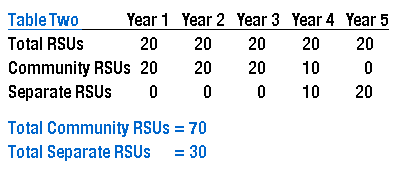
This is often referred to as a Short analysis, named after a somewhat famous case involving a Microsoft employee that was decided by the Washington Supreme Court in 1995, In Re Marriage of Short, 125 Wn.2d 865 (1995).
While a Washington court is free to divide separate and community property however it wants, a good starting point would be to assume that community property is split 50/50 and each party is awarded all of their separate property. In the above example, the programmer would receive half of the 70 community RSUs and all of her 30 separate RSUs for a total of 65 RSUs. Her spouse would receive only half of the 70 community shares for a total of 35 RSUs.
As to how these 35 RSUs (all of which would be unvested at separation) would be transferred to the spouse, the court would order the computer programmer to hold the 35 unvested RSUs in trust for her ex-spouse. Once the 35 RSUs vest, the programmer would then be required to transfer them to an account designated by her ex-spouse.
Employees Often Face Jurisdictional Questions in Divorce for IT Professionals and Software Engineers
It is not uncommon for IT professionals and software engineers across the Seattle area to change jobs several times over the course of their careers. In the Puget Sound tech corridor, a career move may be an internal transfer or a transition between industry giants like Amazon in Seattle, Microsoft in Redmond, or the major engineering hubs of Google and Meta in Seattle and Bellevue. In other instances, tech workers leave established enterprises to join emerging local start-ups. In either event, career changes frequently involve geographic relocations into or out of King County. Because the technology sector is heavily anchored in greater Seattle, career-driven relocations are frequent. When a job change, interstate relocation, and marital separation coincide, tech professionals face critical jurisdictional decisions regarding where to file and how Washington State community property laws will govern their assets, compensation, and unvested equity.
For transplants relocating to the Seattle area from other states or abroad, navigating a marital separation introduces an entirely unfamiliar legal landscape. Many newcomers arriving from non-community property jurisdictions assume that assets earned prior to moving, or accounts held solely in their individual name, remain completely separate. Under Washington law, however, King County Superior Court judges have the authority to review all assets and liabilities, regardless of where they were acquired, to achieve an equitable distribution. Whether you have newly settled in Seattle, Bellevue, Kirkland, or Redmond, dealing with multi-state property, out-of-state real estate, or stock awards earned across multiple jurisdictions requires careful legal analysis. Understanding Washington’s residency rules and property characterization standards early allows transplants to protect their separate assets and avoid costly jurisdictional missteps during a divorce.
Understanding Washington Laws Surrounding Technology Professional Divorce
Under Washington community property law, asset division and spousal maintenance follow distinct standards that directly impact individuals and tech professionals throughout Seattle and King County. When dividing equity compensation, Seattle family courts apply the Short analysis to determine how unvested stock options and RSUs are allocated between marital and separate property. Washington law does not mandate an automatic 50/50 division; instead, King County Superior Court judges are tasked with reaching a “just and equitable” distribution. This grants local courts broad discretion to award disproportionate divisions of community property—and even the authority to “invade” one party’s separate property and award it to the other spouse to achieve fairness.
Regarding spousal support, Washington courts generally reserve long-term or “lifetime” maintenance for marriages lasting 25 years or longer. Navigating these unique community property rules, equity vesting schedules, and spousal support standards can be intricate, making experienced legal counsel essential for tech workers, executives, and couples throughout Seattle, Bellevue, and the greater Puget Sound region.
S.L. Pitts has Experience in and Expertise with Divorce for Technology Professionals
Our Seattle family law attorneys have years of experience representing IT professionals, software engineers, tech executives, and their spouses in divorces across King County and Washington State. From restricted stock units (RSUs) and vesting schedules to complex property division, we understand the unique financial factors impacting tech industry divorces in the Seattle area. If you or your spouse work in technology and are contemplating a separation, consulting an experienced local attorney early is essential to understanding your rights and obligations under Washington law. Early strategic decisions often cast a long and irreversible shadow, especially when addressing jurisdictional questions in King County family courts. Contact our Seattle office today to schedule an appointment with one of our knowledgeable divorce lawyers.
Frequently Asked Questions About Tech Professional Divorce
How are unvested RSUs and stock options divided in a Seattle tech divorce?
Tech compensation packages at employers like Amazon, Microsoft, Meta, and Google rely heavily on equity. In King County divorce proceedings, unvested Restricted Stock Units (RSUs) and stock options are characterized using the Short time-rule formula established in In re Marriage of Short. The court examines the underlying intent of each equity grant. If an RSU grant was awarded to reward past performance during the marriage, the entire grant is typically treated as community property. Conversely, if the grant was structured as an incentive for future employment and retention, Washington courts apply a fractional formula where the community’s interest diminishes over time relative to post-separation labor.
What happens to stock grants awarded during the marriage that vest years after physical separation?
Under Washington’s time-rule analysis, the marital community retains a fractional, steadily diminishing interest in stock tranches that vest post-separation. As the employee spouse contributes separate labor after the physical separation date, the separate property share of each subsequent vesting tranche increases, while the community share diminishes proportionally.
How is illiquid equity in Seattle startups and pre-IPO tech companies handled?
Unlike publicly traded shares with daily market prices, equity in privately held tech startups or pre-IPO companies throughout Seattle and Bellevue lacks immediate liquidity and public valuation. In King County family court, valuing startup equity requires forensic analysis of recent 409A valuations, venture capital funding rounds, capitalization tables, and secondary market transactions. Because startup bylaws and stock restriction agreements almost always prohibit transferring private shares to an ex-spouse, traditional in-kind distribution is rarely straightforward.
How do couples divide startup equity if the shares cannot be legally transferred?
When corporate transfer restrictions or rights of first refusal prevent transferring private shares directly to a non-employee spouse, parties typically use an offsetting buyout or a constructive trust. In an offsetting buyout, the tech employee retains full ownership of the private shares while awarding the other spouse equivalent value through cash, home equity, or retirement assets. Alternatively, a constructive trust allows the employee spouse to hold the non-employee spouse’s beneficial share in trust until an eventual liquidity event, such as an IPO or company acquisition.
How do King County courts calculate spousal maintenance when tech income is largely variable equity?
Tech compensation structures across greater Seattle frequently combine a base salary with substantial, fluctuating RSU vests and annual performance bonuses. Because Washington law does not rely on a rigid statutory formula for spousal maintenance, King County Superior Court judges evaluate overall net cash flow alongside financial need. In cases involving high-earning tech employees, courts often avoid fixing maintenance strictly to a base salary or peak market vesting periods. Instead, maintenance awards are frequently structured with a predictable monthly base payment supplemented by an uncapped or capped percentage tied directly to future stock vesting events and cash bonuses.
Can spousal maintenance be adjusted if a tech downturn, stock drop, or layoff occurs post-divorce?
In Washington State, spousal maintenance is modifiable upon demonstrating a substantial and unanticipated change in economic circumstances. If an employed spouse experiences an involuntary layoff, an unvested equity cancellation, or a severe, sustained market drop that materially impairs their ability to pay, they can petition King County Superior Court for a downward modification of their ongoing support obligation.
Are tech sign-on bonuses and relocation packages considered community or separate property?
In the Puget Sound tech market, significant six-figure sign-on bonuses, retention incentives, and corporate relocation packages are standard hiring perks. Under Washington community property law, the legal characterization turns on whether the bonus was intended to compensate for past marital labor or induce future individual retention. If a sign-on bonus was negotiated to replace unvested equity left behind at a prior employer during the marriage, courts often classify it as community property. However, if the bonus is conditioned on future post-separation employment and remains subject to an active clawback provision, the portion tied to post-separation labor constitutes separate property.
Who is responsible if an employer demands repayment of a sign-on or relocation bonus after separation?
If a tech worker departs an employer and triggers a contractual clawback provision, the resulting debt is characterized under Washington marital liability rules. If the marital community enjoyed the initial financial benefit of the funds, such as using the relocation bonus toward purchasing a Seattle home or covering shared marital expenses, King County courts typically order the repayment liability to be shared equitably between both parties rather than assigned solely to the employee.
How are tech side projects, proprietary code, and software patents evaluated in a Washington divorce?
Many software developers and tech executives across Seattle develop independent software applications, open-source utilities, proprietary algorithms, or side-venture LLCs outside their primary employment. Under Washington State law, all labor, skill, and effort expended by either spouse during the marriage belongs to the marital community. Consequently, any intellectual property, proprietary codebases, or software tools created during the marriage, even those coded during off-hours, are presumed community assets subject to formal valuation and equitable distribution.
Does an employer’s Proprietary Information and Inventions Agreement (PIIA) shield a side venture from divorce division?
While an employer’s moonlighting policy or intellectual property assignment agreement governs legal rights between the corporation and the employee, it does not prevent a Washington family court from evaluating the economic value generated by the marital community. If an independent side venture created marketable intellectual property, commercial licensing revenue, or distinct company valuation, King County judges will factor that appraisal directly into the overall division of the marital estate.